
 tools for tomorrow™
tools for tomorrow™
tools for tomorrow™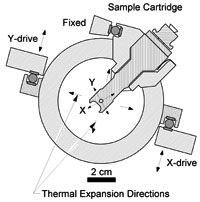
Principle of the Nion stage.
Because all the driving surfaces are parallel to lines that “radiate” out of the stage center, no first-order drift occurs when the whole stage changes temperature.
The sample stage of the Nion microscopes employs symmetry and novel construction principles to minimize sample drift (see figure) and friction. It achieves unprecedented levels of precision: mechanical motion steps in x and y directions as small as 1 nm over a range of ±1.5 mm. Motion in the Z direction (height) enjoys similar precision, as do alpha and beta tilts. Backlash and drift are almost non-existent.
The tilt range with the normal objective polepiece is ±25° along two perpendicular directions. Computer software combines the motions of the stage’s five stepper motors to achieve eucentric tilting along two perpendicular axes.
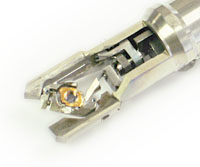 The Nion double-tilt cartridge uses a new mechanism based on a co-axial drive, and achieves precision tilting with minimized backlash and hysteresis and tilt increments as small as 1 mrad (0.05°).
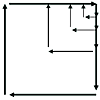 UltraSTEM™ stage x-y motions. The stage moves in decreasing increments (from 2 nm to 0.25 nm shifts) in a square pattern.
If hysteresis and unreleased tension (backlash) were present, each step would start with a small motion parallel to the preceeding one, and the square pattern would rotate as the step size decreases. The absence of such rotation in the movie shows that hysteresis and backlash are less than 1 nm. 2.35 Å and 2 Å gold fringes are visible after each movement, demonstrating the good stability of the stage.
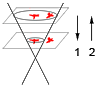 UltraSTEM stage changing defocus by 20 um and returning to original defocus. The ronchigram magnification changes with defocus as the illuminated area of the sample decreases in motion (1), then increases in motion (2).
Minimal backlash and hysteresis gives highly reproducible defocus values and nearly zero shift in x and y.
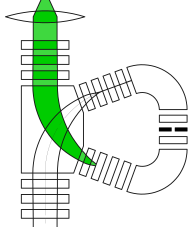 Nion's ultra-high resolution monochromator achieves energy resolution below 10 meV, which opened the door to vibrational spectroscopy in the electron microscope. The monochromator's electron optics is in the "alpha" configuration, which is equivalent to two spectrometers arranged back-to-back with the first half of the monochromator producing a diffraction-limited spectrum in the spectrometer midplane, and the second half canceling the energy dispersion. This results in a diffraction-limited probe at the sample capable of atom-sized electron probes while monochromating.
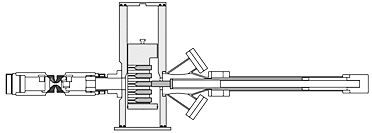
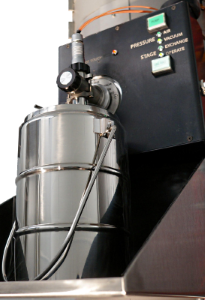
Both the airlock and the sample storage chamber are normally isolated vacuum-wise from the main column. The airlock can be modified to control the sample temperature while exposing the sample to gases at up to atmospheric pressure, and the sample is then introduced into the column for observation without any exposure to air.
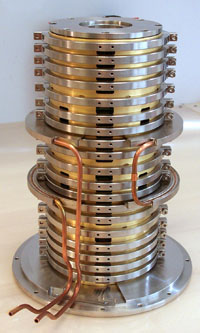 This corrector was developed specifically for Nion’s microscope column. It employs a new design1,2 with major advantages3 over sextupole-round lens correctors. It corrects all aberrations up to and including 5th order ones, and allows illumination semi-angles larger than 40 mrad. Its off-axial (field) imaging properties are comparable to sextupole-round lens correctors, which means that it can readily function also as a CTEM corrector. Because of the high efficiency of quadrupole lenses, it uses less than 1 W of energy, and is therefore very stable even without water cooling.
The corrector comprises 16 quadrupoles and 3 combined quadrupole-octupoles, i.e. approximately three times as many optical elements as Nion’s second-generation corrector for VG microscopes. It is coupled electron-optically to the objective lens using a three-quadrupole lens module. Bringing up of the trajectories in the corrector so that they correspond closely enough to the theoretical model has been automated by Nion’s proprietary software which examines the trajectories stage-by-stage.
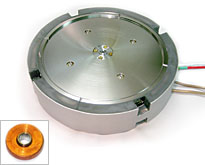
Round lens module for Nion microscope. Module is 60 mm high and contains alignment coils in addition to the main double lens winding. Inset: vacuum interface gasket used for linking modules together.
The Nion microscope column is truly modular – all the modules share exactly the same mechanical interface, and can be stacked in almost any sequence and number. Instead of having a liner tube running through several modules and thus limiting future modifications, the Nion modules are linked vacuum-wise by copper gaskets. These gaskets have proven extremely reliable – none has developed a leak in the microscopes Nion has made so far.
The entire column can be baked at 140°C, which greatly improves attainable vacuum levels and helps prevent contamination of samples. Only metal seals are used in the column, which leads to ultimate vacuum levels in the 10-10 and 10-9 torr range.
The pumping system of the column is also modular. A separate ion pump is used for pumping each major column section. This gives excellent vacuum separation between the gun and the rest of the column, allowing CFEG emission to proceed stably even with the sample at a vacuum in the 10-5 torr range.
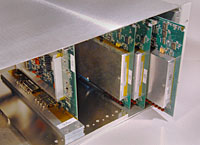 The principal power supplies for the electron microscope come in just two flavors: ultra-stable, low-power supplies used for powering dipoles, quadrupoles and other multipoles, and ultra-stable higher-power supplies for round lenses. The electronics can be flexibly reconfigured to meet whatever special requirements there may be.
The higher-power supplies are packaged two to a PCB to power each regular round lens, which uses two interleaved windings so that it can be run in the constant power mode (pioneered by Topcon microscopes in the 80s). The objective lens uses 4 windings. The low-power supplies are packaged at up to seven supplies per PCB.
There are about 200 power supplies per Nion electron microscope. To manage this complexity, most of the power supplies monitor their own performance, and report to the control software if an instability or any other problem affecting their performance has developed.
 The instrument control software is flexible and modular, and is readily configured to accommodate different possible column configurations. Much of it is automated. Sample exchange, for instance, is accomplished simply by clicking on the desired sample, and the removal of the previous sample and the insertion of the new one is carried out automatically. Proprietary algorithms1 of unsurpassed precision and efficiency analyze captured Ronchigrams to characterize existing aberrations, and automatically tune the microscope for best performance.
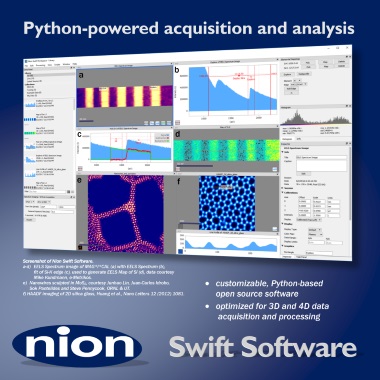
Data capture and analysis are performed using Swift, an open-source Python-based system developed by Nion. This provides enormous versatility for experimental work using the integrated tools and easy incorporation of custom Python code and external packages.